




Most real estate professionals are one slow quarter away from zero. A listing falls through. The pipeline dries up. Income that seemed reliable in Q1 became a problem by Q3.
Property management solves that equation permanently. Every door added to your portfolio raises your monthly revenue floor. The business does not reset between transactions. It compounds.
Portland, Oregon is one of the most structurally sound markets in the country to build that business in 2026 — a metro with 135,346 renter-occupied households, average rents of $1,713/month, and a fragmented property management franchise Portland market dominated by legacy independent operators without technology-first infrastructure.
Why Portland Is a Structurally Renter-Dependent Market
The Portland rental market is not driven by short-term momentum. It is built on structural conditions that have been widening for a decade:
- 135,346 renter-occupied households in Portland, OR — 47% of all households vs. 35% nationally (RentCafe / Yardi Matrix, U.S. Census Bureau ACS, April 22, 2026)
- $1,713/month average rent across all unit types (RentCafe / Yardi Matrix, April 2026)
- $524K median home sale price in March 2026, up 4.8% year-over-year — a wide affordability gap that structurally sustains rental demand (Redfin, March 2026)
- 38,025 additional renter-occupied units in adjacent Vancouver, WA — same metro corridor (Point2Homes / U.S. Census Bureau ACS 2022)
- Portland's urban growth boundary restricts new housing supply — sustaining long-term upward rent pressure (Portland Housing Bureau, 2024 State of Housing Report)
Portland's regulatory environment favors franchise operators
Oregon has had statewide rent control since 2019. The 2026 allowable rent increase is capped at 9.5% (7% + CPI, published by Oregon DAS, September 2025) — once per 12-month period, buildings under 15 years exempt. Portland adds local relocation assistance requirements on top. ORS Chapter 90 governs the full landlord-tenant relationship. ORS 696.241 requires separate trust account management.
For an independent building systems from scratch, this is a recurring compliance burden. For a franchisee operating under documented playbooks already calibrated to Oregon law, it becomes a managed daily routine — and a competitive moat against under-capitalised independents.
Sources: Oregon DAS — oregon.gov/das/oea | Oregon SB 608 (2019) | SB 611 (July 2023) | Multifamily NW — multifamilynw.org | ORS Ch. 90 | ORS 696.241 — oregonlegislature.govProperty Management Creates Recurring Revenue — Not One-Time Commissions
At Portland's April 2026 average rent of $1,713/month and a standard 10% management fee — the NARPM industry benchmark — here is what a growing portfolio generates:
| Portfolio | Base Monthly | Est. Add-ons | Est. Gross |
|---|---|---|---|
| 50 doors | ~$8,565/mo | ~$1,000–$1,750/mo | ~$9,565–$10,315/mo |
| 75 doors | ~$12,848/mo | ~$1,500–$2,500/mo | ~$14,348–$15,348/mo |
| 100 doors | ~$17,130/mo | ~$2,000–$3,500/mo | ~$19,130–$20,630/mo |
| 150 doors | ~$25,695/mo | ~$3,000–$5,000/mo | ~$28,695–$30,695/mo |
Base revenue = 10% management fee × $1,713/month Portland avg (RentCafe / Yardi Matrix, April 2026). Add-on fees estimated from standard industry practice. Fee benchmark: NARPM — narpm.org. Individual results will vary.
Break-even typically occurs between 50 and 75 doors within 12 to 24 months. After that, the business generates compounding monthly income — permanently.
Independent vs. NextBrick Property Management Franchise Portland: The Honest Comparison
Starting independently is possible. But the honest picture includes challenges most operators underestimate — and a growth ceiling most hit earlier than expected.
- Brand credibility: 2–3 years to build from zero in a market where established independents hold years of local equity
- Technology: $600–$1,200/month in self-assembled PM software before managing a single door (IBISWorld, 2025)
- Oregon licensing: 60-hour pre-license course, state exam, $300 fee — before compensated management begins (Oregon REA | ORS 696.020)
- Oregon compliance: 2026 rent cap, ORS Ch. 90, Portland's relocation assistance ordinance, FAIR Act screening, and trust accounting under ORS 696.241 — all self-built, self-documented, self-updated
- Growth ceiling: Most independent operators plateau at 30–60 doors — not because of effort, but because of operational complexity that only proven systems can break through (IBISWorld, 2025)
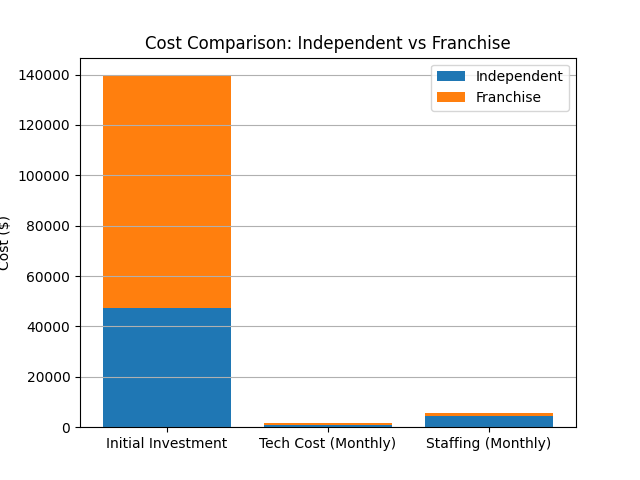
| Category | Going Independent | NextBrick Franchise |
|---|---|---|
| Franchise fee | N/A | $25,000 founding rate (standard: $50,000)* |
| Total investment | $15,000–$80,000+ (2-yr true cost) | $56,500–$128,000 incl. discount* |
| Technology | $600–$1,200/mo — self-assembled | Rentvine + CRM — per-use, no flat fee |
| Remote staffing | $3,000–$6,000+/mo — self-managed | $1,000/mo via Own Door LLC (affiliate) |
| Royalty | 0% | 7% gross — waived first 6 months† |
| Territory | None — open competition | Exclusive (~400K population) |
| Time to break-even | 12–18 months avg | 6–12 months (system-supported) |
| Oregon compliance | Navigate ORS Ch. 90 solo | Playbooks pre-calibrated to Oregon law |
*Standard franchise fee $50,000; $25,000 founding rate for first 10 franchisees. †Royalty waived until 75 properties are managed, whichever comes first. Source: NextBrick Franchise LLC FDD, April 2026, Items 5-7. Independent cost estimates: IBISWorld (2025) and Oregon REA licensing data.
Portland's property management market is served predominantly by legacy independent operators — most without modern technology infrastructure, national brand backing, or documented operational systems. For a franchisee entering with established infrastructure, brand credibility, and Oregon-calibrated compliance playbooks, this fragmentation is a structural acquisition opportunity rather than a saturated competitive field.
Source: IBISWorld, Property Management in the US, April 2025 — 335,000+ businesses nationally, dominated by small independent operators | NextBrick operational assessment, 2026Why NextBrick Is Strategically Positioned in Portland
NextBrick is a Bellevue, WA-based single-family property management company with 650+ properties managed, a 4.7-star brand rating, and 99.9% on-time rent collection. The franchise model is built on the same operational infrastructure that produced those results — franchisees inherit a working system, not a startup model being tested in a new market.
- Rentvine PM software + approved CRM — per-use licensing, no large flat fee upfront
- 363-page operations manual refined across 650+ managed properties — every process documented
- Own Door remote staffing: $1,000/month flat via NextBrick affiliate Own Door LLC
- Exclusive territory — approximately 400,000 population, no NextBrick competitor in your designated area
- Oregon compliance playbooks pre-calibrated to ORS Ch. 696, ORS Ch. 90, and Portland's local tenant protection ordinances
- Veteran discount: 15% off franchise fee | RE professional credit: $5,000 post-opening for active licensees
Investment overview
| Investment Item | Estimated Range |
|---|---|
| Franchise fee (founding rate — first 10 franchisees) | $25,000 (standard: $50,000) |
| Technology & software setup (Rentvine + CRM) | $2,000–$5,000 |
| Working capital — 6 months | $20,000–$40,000 |
| Local marketing & launch | $5,000–$15,000 |
| Oregon licensing & legal | $1,500–$4,000 |
| TOTAL ESTIMATED INVESTMENT | $56,500–$128,000 |
Source: NextBrick Franchise LLC, FDD April 2026, Items 5-7. Full breakdown: nextbrickfranchise.co/property-management-franchise-cost. SBA 7(a) financing available, subject to eligibility, lender approval, and minimum 10% equity injection (SBA policy, June 2025).
Frequently Asked Questions
What is a property management franchise Portland operators should consider?
A property management franchise is a licensed business managing rental properties on behalf of landlords under an established brand — handling tenant placement, rent collection, maintenance coordination, and owner communication. Revenue comes from recurring monthly management fees of 8%–12% of collected rent per property, every month, regardless of transaction volume. In Portland, the opportunity is defined by 135,346 renter-occupied households (47% of all households), $1,713/month average rent, and a market served predominantly by independent operators without technology-first infrastructure. Unlike a transaction-based real estate business, every door added to the portfolio raises the monthly revenue floor permanently — the income model compounds rather than resets. (Sources: RentCafe / Yardi Matrix, U.S. Census Bureau ACS, April 2026 | NARPM — narpm.org)
How much does a property management franchise cost in Portland?
Total estimated investment: $56,500–$128,000. This covers the franchise fee ($25,000 founding rate for the first 10 franchisees; standard $50,000), technology setup via Rentvine PM software and approved CRM ($2,000–$5,000), six months of working capital while building the portfolio to break-even ($20,000–$40,000), local marketing and launch ($5,000–$15,000), and Oregon licensing and legal fees ($1,500–$4,000). The largest variable in the range is working capital — held while building the portfolio to the 50–75 door break-even milestone. SBA 7(a) financing is available and commonly used at this investment level, subject to eligibility requirements, lender approval, and a minimum 10% equity injection for startup loans (SBA policy, June 2025). (Source: NextBrick Franchise LLC, FDD April 2026, Items 5-7 — nextbrickfranchise.co/property-management-franchise-cost)
Do I need a real estate license to start a property management business in Portland?
Yes. Under Oregon Revised Statutes Chapter 696 (ORS 696.020), managing rental properties for compensation requires either a real estate broker license or Oregon's standalone property manager license. The property manager license is the most direct path — it requires completing a 60-hour pre-license course from an Oregon Real Estate Agency-approved school, passing a state licensing exam, and paying a $300 non-refundable application fee. The broker license requires 150 hours of pre-license education. Oregon eliminated the salesperson license category — the three active license types are Broker, Principal Broker, and Property Manager. Either the Broker or Property Manager license satisfies the legal requirement to collect rent on behalf of property owners. This license must be obtained and active before beginning any compensated management activity. (Sources: Oregon Real Estate Agency — oregon.gov/rea | ORS 696.020 — oregonlegislature.gov | Oregon Admin Rules 863-022-0015 — sos.state.or.us)
How long does it take to reach break-even in property management?
Break-even for a new property management operation typically occurs between 50 and 75 managed doors, usually within 12 to 24 months from launch. At Portland's April 2026 average rent of $1,713/month and a standard 10% management fee (the NARPM industry benchmark), 50 doors generates approximately $8,565/month in base management revenue — plus an estimated $1,000–$1,750/month in add-on fees such as leasing, renewal, and maintenance coordination. At 75 doors, base revenue approaches $12,848/month. The timeline varies based on operator execution, local network strength, and the infrastructure in place at launch. Franchise operators — with brand credibility, configured technology, and operational playbooks from day one — consistently reach break-even faster than independents building those systems from scratch, who typically spend 12–18 months in pre-revenue infrastructure development before closing their first management agreement. (Rent data: RentCafe / Yardi Matrix, April 2026 | Fee benchmark: NARPM — narpm.org | Investment data: NextBrick Franchise LLC FDD, April 2026)
Which property management franchise is best to invest in for 2026?
The strongest property management franchise investment for 2026 combines four elements: technology-driven operations that scale without proportional staffing cost increases, a remote staffing model that keeps overhead low during portfolio growth, transparent FDD fee disclosure with no hidden cost layers, and a high-demand territory with structural rental demand rather than speculative market conditions. NextBrick currently offers a $25,000 founding franchise fee for the first 10 franchisees (standard: $50,000), a 7% royalty waived for the first six months and until 75 properties are managed — whichever comes first, built-in remote staffing via Own Door LLC at a flat $1,000/month, and exclusive territory rights covering approximately 400,000 population. Franchisees receive a 363-page operations manual, Oregon-calibrated compliance playbooks, and ongoing support from an operator that has managed 650+ single-family properties. The Portland territory is currently available. (Source: NextBrick Franchise LLC, FDD April 2026, Items 5-7 — nextbrickfranchise.co)
Ready to Explore the Portland Territory?
Portland has 135,346 renter-occupied households. Average rents are $1,713/month. Oregon's regulatory environment favors operators with proven compliance infrastructure. The first-mover window is open.
Book a Free 30-Minute Discovery Call
Founding franchisee spots are limited. The Portland territory is currently available.