




Rental vacancy rates across the Pacific Northwest hit near-record lows in 2024, while the US property management industry crossed $26 billion in market value — accelerating toward $30.5 billion by 2030 (Grand View Research, 2024). That is not a niche opportunity. It is a structural shift, and most of the market remains unmanaged.
If you are a licensed realtor navigating commission compression, or an independent property manager who has hit the ceiling without systems, this guide is written for you. What follows: real property management franchise costs, honest ROI benchmarks, seven red flags to screen before you sign, and a clear-eyed case for why 2026 is among the best entry points this industry has seen in a decade.
No filler. No hype. Just the data and the framework to make a smart decision.
Why 2026 Is the Right Year to Enter Property Management Franchising
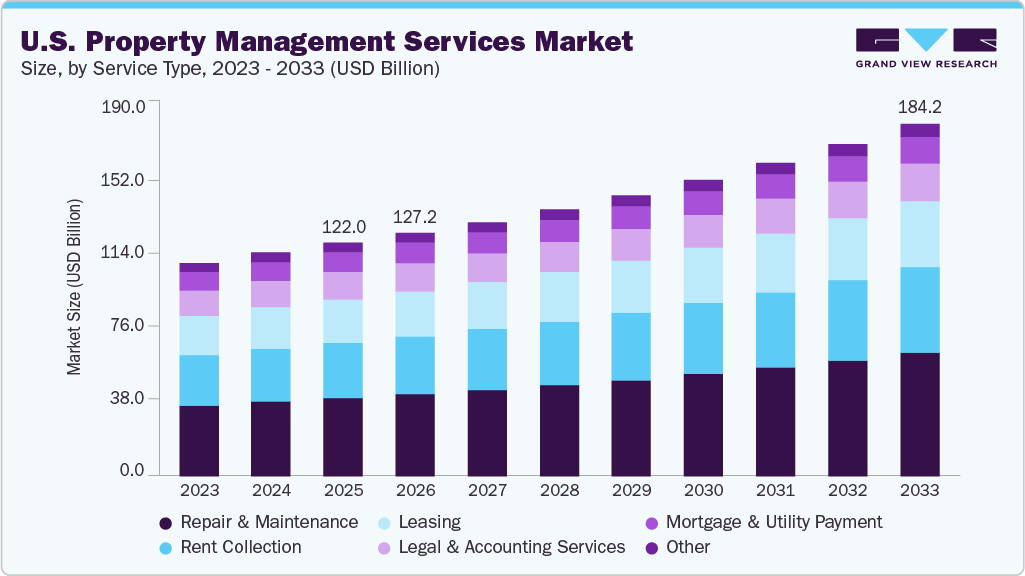
The case for a property management franchise in 2026 is not built on optimism. It is built on four converging data points that each independently support the investment — and together make a compelling argument for moving now.
The Market Is Growing and Still Under-Managed
The US property management market is projected to reach $30.5 billion by 2030, growing at 8.5% CAGR (Grand View Research, 2024). Yet only 44% of US rental properties are professionally managed — meaning the majority of the market remains an open opportunity for qualified operators (NARPM/Buildium, 2023).
Source: Grand View Research, Property Management Market Report, 2024; NARPM/Buildium, State of the Property Management Industry, 2023The Pacific Northwest Rental Market Is Structurally Tight
Rental vacancy rates across the Vancouver WA and Portland OR metro areas remain well below the national average, driven by in-migration, tech-sector employment, and homeownership affordability at multi-decade lows. Portland-Vancouver metro median rents have grown consistently year-over-year, outpacing wage growth and keeping rental demand elevated (Apartment List, 2024).
Source: Apartment List, National Rent Report, 2024; US Census Bureau, American Community Survey 2023Franchising Dramatically Reduces the Risk of Starting a PM Business
Franchise businesses maintain a five-year survival rate of approximately 85%, compared to roughly 50% for independent startups. The gap is directly attributable to the operational infrastructure — systems, brand recognition, and training — that a franchise provides and an independent operator must build from scratch.
Source: International Franchise Association (IFA); US Small Business Administration franchise vs. independent business dataThe rental market is growing. A significant share remains unprofessionalized. The property management franchise model offers the most capital-efficient entry point into the space. That combination does not appear often.
→ Explore the franchise opportunity overview
What Does a Property Management Franchise Actually Cost in 2026?
Property management franchise cost is one of the most searched terms in this category — and one of the most poorly answered. The real answer requires separating three tiers: entry-level, mid-tier, and established national brands. Here is how the math actually works.
Industry Investment Tiers
| Operator Tier | Franchise Fee | Total Investment | Typical Royalty |
|---|---|---|---|
| Entry-Level Operators | $15,000–$25,000 | $40,000–$80,000 | 6%–8% |
| Mid-Tier Operators | $25,000–$40,000 | $80,000–$130,000 | 7%–9% |
| Established National Brands | $40,000–$60,000+ | $100,000–$200,000+ | 8%–10%+ |
What Each Cost Line Item Covers
- Franchise fee: Upfront license to operate under the brand. Covers systems, trademark, and initial support.
- Technology fee: Monthly/annual charge for the franchisor's PM software platform. Ranges from $0 to $500+/month.
- Brand development fee: Contribution to the franchisor's marketing fund. Typically 1%–3% of gross revenue.
- Training and onboarding: Initial training cost — from a short orientation to a multi-week structured launch curriculum.
- Working capital: Cash reserve to cover operating expenses before recurring revenue stabilizes. Plan for 6–12 months.
- Insurance: General liability and E&O insurance required by most franchisors. Typically $2,000–$5,000 annually.
Property management franchise royalties typically range from 6%–10% of gross revenue (FranData; Franchise Business Review). Stacked with technology fees and brand development contributions, total franchisor obligations can reach 10%–15% of gross revenue — a meaningful margin drag if not modeled in advance.
Source: FranData, FDD benchmarks; Franchise Business Review, 2023Where Next Brick Sits in This Landscape
Next Brick's 2025 Franchise Disclosure Document places its total investment at $57,000–$128,000, with a founding franchise fee of $25,000 for the first 10 franchisees. The royalty rate is 7%, waived entirely for the first six months of operation. Technology fee: $0. Brand development fee: $0.
Source: Next Brick Franchise Disclosure Document, 2025, Items 5, 6, and 7That fee structure positions Next Brick at the intersection of accessible and serious. Low enough for a working realtor or small-portfolio manager to self-fund without SBA financing or outside capital. Structured enough to reflect a real operational business — not a license-and-forget model.
Property Management Franchise ROI: What the Numbers Actually Look Like
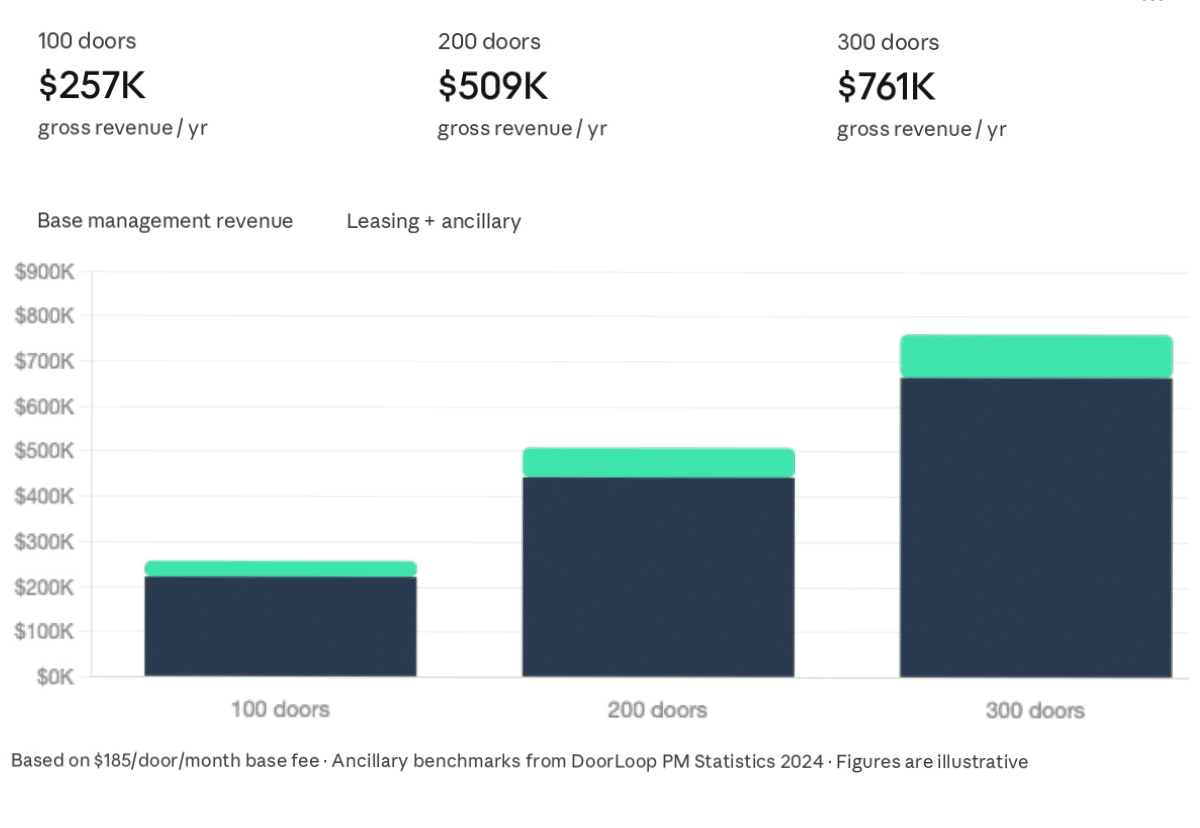
Property management is not a get-rich-quick play. It is a compounding business — each door added raises recurring revenue with minimal marginal cost. The property management franchise ROI case is built on that compounding, and it becomes more compelling the longer the model runs.
The Revenue Model
Management fees in the Pacific Northwest run 8%–12% of monthly rent per door, with most operators pricing at 9%–10% (DoorLoop, 2024). At Portland-Vancouver's median rent of $1,850/month (Apartment List, 2024), a 10% management fee generates ~$185 per door per month in base management revenue.
Source: DoorLoop, Property Management Statistics Report, 2024; Apartment List, National Rent Report, 2024Layered on top of that base: leasing fees (typically 50%–100% of one month's rent per new tenancy), lease renewal fees ($150–$350), maintenance coordination fees ($25–$75 per work order), and onboarding fees ($150–$500 per new property). A well-structured PM business generates three to five revenue streams per door annually.
Three Portfolio Scenarios
| Portfolio Size | Est. Base Revenue/yr | Leasing + Ancillary | Total Gross Revenue |
|---|---|---|---|
| 100 Doors | $222,000 | ~$35,000 | ~$257,000 |
| 200 Doors | $444,000 | ~$65,000 | ~$509,000 |
| 300 Doors | $666,000 | ~$95,000 | ~$761,000 |
Margins and Break-Even
Property management franchise owners operating mature portfolios achieve EBITDA margins of 20%–35%, improving as door count scales above 100 (DoorLoop, 2024; Franchise Business Review). Fixed costs — technology, insurance, base staffing — remain largely constant as the portfolio grows, driving margin expansion at scale.
Source: DoorLoop, Property Management Statistics Report, 2024; Franchise Business Review, 2023At the 100-door mark — the widely cited profitability inflection point in property management — a franchisee running a tight operation typically recovers their initial investment within 18–24 months, depending on ramp-up pace and local market conditions. This is a benchmark the reader can audit using the revenue and margin figures above.
Want to Model the Numbers for Your Market?
Book a free, no-obligation discovery call. We'll walk through territory data and a real projection for Vancouver WA or Portland OR.
7 Things to Evaluate Before You Sign a Property Management Franchise Agreement
A franchise agreement is a multi-year legal and financial commitment. The seven criteria below represent the difference between a franchise that delivers on its promise and one that collects a fee and leaves you to figure out the rest.
- Proven operational track record. How many properties does the franchisor actually manage — not market, manage? Look for verifiable portfolio size, client retention, and independent ratings. A franchisor with a live portfolio has tested their systems under real conditions. One that operates purely as a franchise sales business has not.
- Transparent FDD with a reasonable fee structure. Read Items 5, 6, and 7 carefully. Flag hidden technology fees, excessive royalties, and ambiguously defined territories. Total franchisor fees — royalty plus technology plus marketing fund — should be calculable before you sign.
- Technology and software infrastructure. Does the franchisor provide a best-in-class platform, subsidize it, or expect you to source your own? A $0 technology fee is meaningfully different from $300–$500/month at scale.
- Staffing model and scalability. Labor is the largest variable cost in property management. Ask specifically: does the franchisor have a structured staffing model, a staffing partnership, or any infrastructure beyond a suggestion to post on Indeed?
- Protected territory with real market data. Demand a territory map with census-based rental housing stock figures. Understand your total addressable market before you sign. Undefined territories create conflict later and limit your ceiling.
- Onboarding and training quality. Is there a structured launch program with defined milestones, or are you handed a manual and a phone number? Onboarding quality directly predicts how quickly you acquire your first 25–50 doors.
- Franchisor skin in the game. Does the founder actively manage properties themselves? A franchisor who has built and operated a real portfolio has earned the right to sell you a system. One who has not is selling a concept.
These seven criteria function as a filter. A strong franchise investment passes all seven. A mediocre one fails at least three.
→ View territory map and availability
Why Next Brick Is the Property Management Franchise Built for 2026
Against those seven criteria, here is how Next Brick franchise performs — evaluated with data, not marketing language.
Built by an Operator, Not a Franchise Developer
Next Brick was founded by Seemant Nakra in Bellevue, Washington — an active property management operator who built the business from the ground up in the competitive Pacific Northwest market before launching the franchise program. Next Brick currently manages 650+ properties, holds a 4.7-star verified rating across independent platforms, achieves 99.9% on-time rent collection, and has earned Expertise.com recognition as a top Seattle-area property management company for five consecutive years (Next Brick, 2026).
Source: Next Brick internal verified data, 2025; Expertise.com, Top Property Management Companies — Seattle, WA, 2022–2026Seemant built the system before selling it. That is criterion one — and it is not a feature most franchise programs in this space can honestly claim.
The Most Strategically Priced Investment in the Sector
At $57,000–$128,000 total investment and a $25,000 founding franchise fee, Next Brick is within self-funding range for a working realtor or small-portfolio property manager in the Pacific Northwest — no SBA financing or outside capital required. The 7% royalty is waived for the first six months, meaning franchisees build revenue before the royalty structure activates. Technology fee: $0. Brand development fee: $0. (Next Brick FDD, 2026)
Source: Next Brick Franchise Disclosure Document, 2026, Items 5, 6, 7For context: mid-tier established operators in this space typically charge $80,000–$130,000 in total investment plus ongoing technology and brand fund fees that compound monthly. Next Brick does not. That delta is real money.
The Own Door Advantage — No Equivalent Exists in US Property Management Franchising
The staffing scalability question from Section 4 — how do you grow a portfolio without bloating local payroll — has a structural answer in the Next Brick model. Next Brick's strategic partnership with Own Door gives franchisees access to trained, cost-effective remote property management staff, integrated into the operational workflow from day one.
No other US property management franchise currently offers an equivalent structured remote staffing model (Next Brick Franchise, 2025). For a franchisee, this translates directly: lower labor cost per door, faster path to the 100-door profitability threshold, and the ability to price competitively to landlords without sacrificing margin.
Source: Next Brick Franchise, 2025 — Own Door partnership verified as unique in US PM franchise sectorPacific Northwest Timing: Vancouver WA and Portland OR
The Vancouver WA property management franchise and Portland OR property management franchise opportunities through Next Brick sit in two of the fastest-growing rental markets in the Western US. Median rents in the Portland-Vancouver metro grew year-over-year through 2024, vacancy rates remain below the national average, and the region continues to attract net in-migration from higher-cost California and Seattle markets (Zillow Research, 2024; Apartment List, 2024).
Source: Zillow Research, Pacific Northwest Rental Market Data, 2024; Apartment List, National Rent Report, 2024; US Census Bureau, Portland-Vancouver-Hillsboro MSA, 2023Both the Vancouver WA and Portland OR markets remain underserved by franchise-quality property management. Institutional operators have not saturated the Pacific Northwest mid-market. That gap is the opportunity.
Early-Mover Advantage Is Real and Time-Limited
The founding cohort of 10 franchisees receives the $25,000 founding fee, first access to territory selection, and direct access to founder's support and the operational team during the buildout phase. The reader is, by definition, evaluating this at the right moment — not after the best territories are gone.
→ Explore the full franchise opportunity
Q: How much does a property management franchise cost in 2026?
A: $57,000–$128,000 total investment (Next Brick FDD, 2025), with a $25,000 founding fee for the first 10 franchisees. Technology fee: $0. Brand development fee: $0. Royalty of 7% waived for the first six months. Industry range: ~$40,000 to $200,000+. (Franchise Business Review, 2023)
Q: Is a property management franchise profitable?
A: Yes — management fees of 8%–12% per door create predictable recurring revenue. Most franchisees reach break-even within 18–24 months at the 100-door mark, with EBITDA margins of 20%–35%. (DoorLoop, 2024; Franchise Business Review, 2023)
Q: What makes Next Brick different from other property management franchises?
A: Three differentiators stand out: (1) Own Door remote staffing — no U.S. franchise equivalent; (2) $0 technology and brand development fees; (3) founding cohort of 10 — protected territories and a 650+ door operational blueprint from an active operator.
Q: Why are Vancouver WA and Portland OR strong markets for a property management franchise?
A: Strong rental demand, consistent rent growth, below-average vacancy, and significant net in-migration — with ~38% renter-occupied households (U.S. Census Bureau, 2023) and limited franchise-quality competition in the mid-market segment.
The Cost of Staying Where You Are
The property management franchise opportunity in 2026 is grounded in data: a $26 billion market growing at 8.5% annually, a Pacific Northwest rental corridor with structurally elevated demand, and a franchise model that reduces startup risk while compressing the time to profitability. The market will not wait.
If you are a realtor, another year of commission volatility is another year of rebuilding income from zero each January. If you are an independent property manager with under 50 doors, another year without systems, brand, and staffing infrastructure is another year of ceiling. Neither is a strategy.
The best property management franchise 2026 has to offer is not the cheapest one or the most recognized one. It is the one built by an operator who has already done the work — and structured the investment so that a serious professional can enter without requiring outside capital or a decade of runway.
Next Brick is that franchise. The founding cohort is open. The Pacific Northwest territories are available now.
Ready to Build a Business on a System That Already Works?
Book your free discovery call today. Founding franchisee spots are limited — territories will not stay open indefinitely.