



The decision between a property management franchise vs going independent is the most consequential choice a real estate professional will make in 2026. If you've been in the industry for a few years, you've felt it. The transactional grind of closing deals is exhausting. Commissions are inconsistent. And somewhere in the back of your mind, you know there's a more scalable model.
Property management is that model — recurring fees, predictable revenue, a business that compounds over time. But here's what most people don't tell you:
This is the decision defining real estate careers in 2026: property management franchise vs going independent — do you build alone, or plug into a proven system? Here are the real numbers behind both paths.
$128B U.S. property management industry · 44M+ renter-occupied households · 17M individual landlords increasingly ready to outsource.
(Sources: IBISWorld 2025; U.S. Census Bureau ACS 2024; Pew Research Center 2023)
Going Independent: The Reality Check

Starting an independent property management company sounds straightforward — get a license, find clients, manage properties. The reality is considerably harder.
Lead generation is a full-time job
Property owners selecting a property manager rely heavily on reputation and referrals as the primary decision factors, according to industry research from the National Association of Residential Property Managers.
Source: NARPM Industry Survey, 2023As a new independent, you have neither — and acquiring your first 20–30 clients costs $400–$800 per new client in year one.
Source: IBISWorld, 2024Compliance, staffing, and technology overhead
Most U.S. states require a broker's license for property management. Washington, Oregon, California, Texas, and Florida — five of the most active rental markets — are non-negotiable.
Property management firms spend 38–42% of gross revenue on staffing. (Source: BLS, 2024) Add a self-assembled technology stack — PM software, CRM, leasing tools — and you're spending $600–$1,200/month before managing your first property.
The time and profitability gap
NARPM found independent PMs work 55–70 hours per week in years one through three while managing fewer than 50 units. (Source: NARPM Industry Survey, 2023) Average time to stable profitability: 12–18 months. (Source: BLS, Small Business Survival Data, 2024)
None of this makes independent PM impossible. But it explains why the average independent operator plateaus between 30–60 doors — overwhelmed by operational complexity before they ever build the systems to scale.
What Is a Property Management Franchise?
A property management franchise gives you the legal right to operate under an established brand, using their systems, software, training, and operational frameworks — in exchange for a franchise fee and ongoing royalties.
What a strong franchise provides:
- Tested operational playbook from day one
- Brand recognition that shortens client trust-building
- Designated integrated technology — no assembling tools from scratch
- Exclusive protected territory (~400K population) — no internal competition
- Remote staffing infrastructure (in the best models)
- Ongoing support: operations, compliance, marketing, training
Cost & ROI Comparison: Property Management Franchise vs Going Independent
| Category | Going Independent | Next Brick Franchise |
|---|---|---|
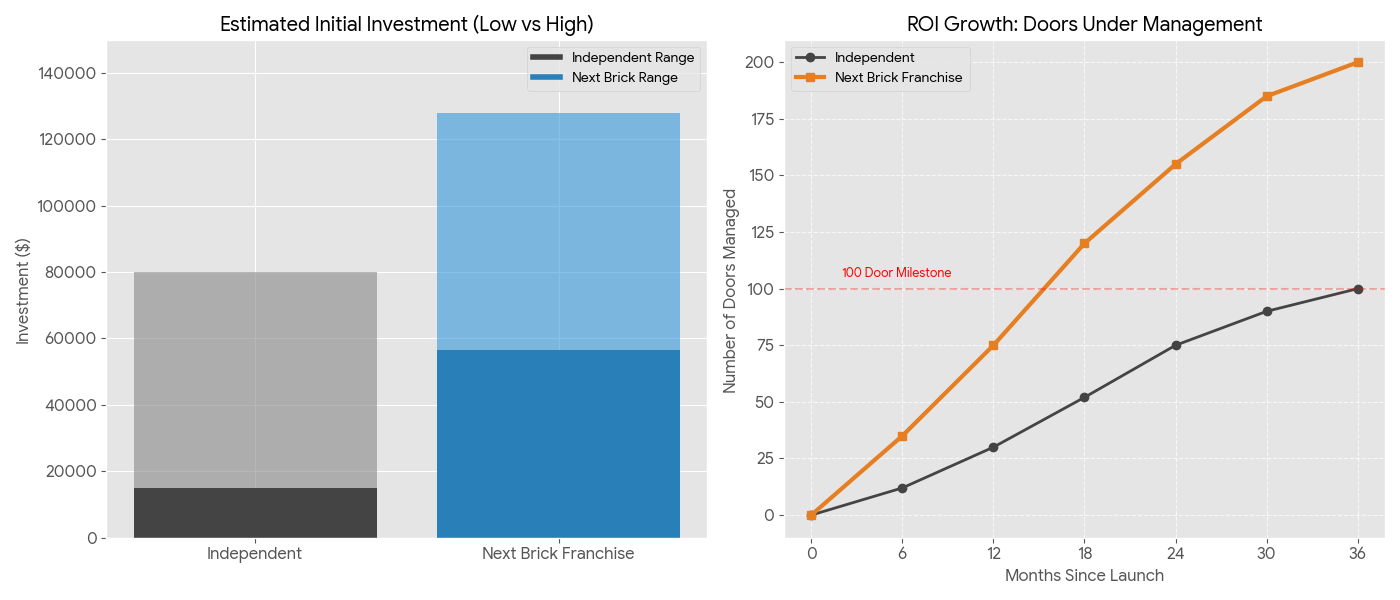
| Initial investment (all-in) | $15,000–$80,000+ (true 2-yr cost) | $56,500–$128,000 (with launch discount)* |
| Technology stack | $600–$1,200/mo (self-assembled) | Designated (Rentvine + CRM) — per-use rates |
| Remote staffing | $3,000–$6,000+/mo (self-hired) | $1,000/mo via Own Door LLC (affiliate) |
| Training & operations manual | $2,000+ (external) or none | 3-week program + 363-page manual — no fee |
| Royalty | 0% | 7% gross sales — waived first 6 months† |
| Territory protection | None — open competition | Exclusive (~400K population) |
| Time to launch | 3–6 months average | 1–3 months from signing (FDD Item 11) |
| Time to profitability | 12–18 months average | 6–12 months (system-supported) |
| Marketing support | Fully self-funded, no templates | Pre-approved campaigns and templates provided |
| Owner hrs/week (Year 3) | 60–80 hrs | 30–40 hrs (system-driven) |
| Brand development | $5,000–$20,000+ (DIY) | $0 (brand provided) |
| 100 doors (Year 3 revenue) | ~$17,000/mo ($204,000/yr) at $170/door — 60–80 hrs/week | ~$17,000/mo ($204,000/yr) reached 12–18 months faster — 30–40 hrs/week |
*Standard franchise fee $50,000; launch discount (50% off) for first 10 franchisees. †Royalty minimum also waived until 75 properties managed — whichever comes first. Source: Next Brick Franchise LLC, FDD April 2026, Items 5–7. Revenue scenario at $170/door/month average management fee (U.S. avg. rent ~$1,700 × 10% standard management fee). Sources: IBISWorld 2025; NARPM Market Survey 2024; BLS 2024.
Curious How This Works in Your Specific Market?
View the full cost breakdown or book a 20-min discovery call.
Challenges: Property Management Franchise vs Going Independent
| Area | Going Independent | Franchise Model |
|---|---|---|
| Lead generation | Build referrals from scratch — no brand recognition, 6–12 months | Brand + marketing framework + approved campaigns from day one |
| Scaling past 50 doors | Requires full rebuild of operations, systems, and team | System designed for 50–200+ doors — plug-and-play operational playbook |
| Technology | Assemble & pay per tool — $600–$1,200+/mo ongoing | Designated integrated platform — no tool-shopping |
| Compliance & licensing | Navigate solo — costly to stay current across states | Franchisor guidance and documented compliance processes |
| Staffing / remote team | Full recruiting, training, and management burden | Own Door affiliate — trained remote staff at $1,000/mo |
| Revenue predictability | Highly variable — dependent on deal flow and referrals | Recurring, subscription-like model from the start |
| Marketing | Fully self-funded — create every piece from zero | Pre-approved materials + strategy + digital media framework |
| Risk | High — no roadmap, no safety net, all learning costs money | Lower — proven model, FDD disclosure, established franchisor support |
| Brand trust | Earned slowly over years — often 3–5 year gap | Transferred on day one via Licensed Marks and established brand |
| Ongoing support | None — every problem is yours alone | Operations, compliance, marketing, training — ongoing |
Why Franchising Wins in 2026
- Rental demand is structural: U.S. homeownership at 65.6% — near a two-decade low. More renters = more properties to manage. (Source: U.S. Census Bureau, Q4 2024)
- Individual landlord fatigue: 17 million individual landlords, most managing 1–4 properties, are increasingly outsourcing as self-management complexity grows. (Source: Pew Research Center, 2023) This is the franchise operator's primary acquisition pipeline.
- Technology gap is widening: Property management software market growing at 6.9% CAGR through 2030. (Source: Grand View Research, 2024) Franchise systems integrating technology outperform independent operators building from scratch — and the gap widens every year.
Portland & Vancouver, WA: A Market Built for This Model

Vancouver, WA: 38,000+ renter-occupied units — no direct franchise competitor with our staffing model currently operating.
(Source: U.S. Census Bureau, ACS 2023)
Vancouver, WA sits at the intersection of Oregon's large rental market and Washington's lower tax environment — attracting investors and long-term renters alike. Clark County's high individual landlord penetration creates a direct pipeline of self-managing owners ready to outsource. For realtors already active in this region, property management is a natural extension — converting transactional income into recurring monthly revenue from the same clients you already serve.
As of 2026, neither the Portland metro nor the Vancouver, WA market has a direct franchise competitor operating Next Brick's integrated remote staffing model — making both markets available for first-mover franchise operators.
When independent is the right call
Franchising is not the right fit for every operator. If you already have established brand recognition in your market, a proven referral pipeline, and the capital and time to build your own systems from scratch, an independent structure gives you full control with no royalties. Operators who thrive independently tend to be deeply embedded in a single local market and willing to invest 2–3 years building the operational infrastructure a franchise provides on day one. Both paths can succeed — the question is which one matches where you are right now.
Next Brick Franchise: Built for This Market
Next Brick is a Bellevue, WA-based property management franchise managing 650+ single-family properties across WA — with a 4.7-star reputation and 99.9% on-time rent collection. Built specifically for realtors and PMs who are tired of building everything alone.
| What Next Brick Provides | Detail |
|---|---|
| Own Door remote staffing | Built-in remote team model via our affiliate Own Door, LLC — $1,000/mo flat. The only U.S. PM franchise offering this integration. |
| Designated technology | Rentvine (PM software) + approved CRM — no tool-shopping. Ongoing per-use licensing, no large upfront tech cost. |
| Franchise fee (founding rate) | $25,000 for first 10 franchisees (standard fee: $50,000). Real estate license holders get additional $5,000 credit. |
| Total investment range | $56,500–$128,000 with launch discount (FDD: $81,500–$153,000 standard). Single territory, ~400,000 population. |
| Royalty structure | 7% of gross sales — waived for first 6 months post-opening OR until 75 properties managed (whichever comes first). |
| Training | 3-week onboarding at Bellevue, WA facility. No training fee for owner + 1 manager. |
| Time to launch | 1–3 months from signing (FDD Item 11 estimate). Open within 120 days required. |
| Territory protection | Exclusive operating territory — no Next Brick competitor in your market. |
The Own Door remote staffing integration is the detail that separates Next Brick from every other property management franchise in the U.S. market. When weighing a property management franchise vs going independent, this is the variable most operators underestimate: you don't have to solve the staffing problem yourself. A fully trained remote professional supports your portfolio from day one, allowing you to scale without proportionally increasing your local headcount.
Ready to See If a Next Brick Territory Is Available?
Founding franchisee spots are limited. Pacific Northwest territories won't stay open indefinitely.
Key Takeaways
- $128B property management industry — demand is structural and growing. (IBISWorld, 2025)
- 17M individual landlords ready to outsource = your primary acquisition pipeline. (Pew Research, 2023)
- Independent PMs plateau at 30–60 doors due to systems failure, not effort.
- Franchise operators reach 120–200+ doors by Year 3 — at half the weekly hours.
- Portland and Vancouver, WA: high-demand, underserved, no direct franchise competitor with our staffing model.
- Best franchise in 2026 = technology + remote staffing + territory protection + transparent FDD.
Frequently Asked Questions
Is a property management franchise worth it in 2026?
Yes — for the right operator. A property management franchise compresses the ramp-up period, provides operational infrastructure from day one, and reduces the risk of building from scratch. With sustained rental demand and 17 million individual landlords increasingly outsourcing, the structural tailwinds are strong. Operators like Next Brick are built for professionals entering the space — $25,000 founding fee (first 10 franchisees), 6-month royalty waiver, full training and operations manual included. (Source: Next Brick Franchise LLC, FDD April 2026)
How profitable is property management?
Highly profitable at scale. At a 10% management fee on a $1,700 average U.S. monthly rent, each door generates ~$170/month. 100 doors = $17,000/month ($204,000/year) in management fees alone — before leasing, maintenance, and renewal revenue. The BLS reports a median salary of $61,000 for property managers (BLS, 2024), but owner-operators managing growing portfolios exceed this significantly as door count scales. Fixed overhead (technology, admin) does not scale proportionally with doors — profitability improves substantially above 50 doors.
What is the biggest challenge in property management?
Scaling. Most operators manage 15–20 doors through personal effort. Growing to 100+ doors without proportionally increasing your time requires systems, team, and processes — the exact gap franchise models fill. NARPM data shows independent PMs work 55–70 hours per week in years one through three while managing under 50 units. (NARPM, 2023) Franchise systems provide the operational infrastructure independent operators spend years building through trial and error.
What should I look for in a property management franchise?
Six things: (1) Technology — designated and integrated, not self-assembled. (2) Territory — exclusive protection confirmed in the FDD. (3) Staffing — does the model facilitate a remote team? (4) Transparency — is there a current FDD with clear fee disclosure? (5) Royalty structure — when does it start, and is there a waiver period? (6) Active operations — does the franchisor actually manage properties? Next Brick answers all six: 650+ active properties, Rentvine + CRM tech stack, Own Door remote staffing, 2026 FDD, and a 6-month royalty waiver.
Which property management franchise is best to invest in for 2026?
The best fit for 2026 combines technology-driven operations, remote staffing, and a transparent fee structure in a high-demand market. Next Brick is currently the only U.S. PM franchise offering built-in remote staffing (Own Door, LLC) alongside a designated technology stack, with a $25,000 founding fee for the first 10 franchisees. For operators in Portland, OR or Vancouver, WA — active territories are available, with exclusive market rights and no direct franchise competitor operating our staffing model in either market. (Source: Next Brick Franchise LLC, FDD April 2026, Items 5–7)
What are typical property management franchise fees?
Franchise fees in property management range from $25,000–$55,000 upfront, with ongoing royalties of 6–10% of gross revenue. Some franchisors add separate technology, brand development, and marketing fees. Next Brick's 2026 FDD discloses a $50,000 standard fee ($25,000 with the founding-franchisee launch discount for the first 10 qualified franchisees), 7% royalty waived for the first 6 months, and per-use technology licensing rather than a flat add-on. Active real estate license holders receive an additional $5,000 credit. (Source: Next Brick Franchise LLC, FDD April 2026, Items 5–6)
Ready to See If a Next Brick Territory Is Available in Your Market?
Book a no-pressure 20-minute discovery call.